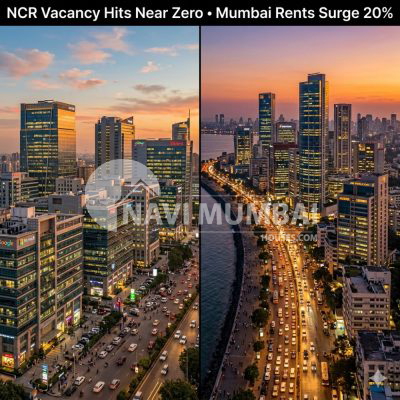
NCR Office Vacancy Hits 0–2% as Mumbai Rents Surge 20%
India’s commercial real estate market is changing rapidly. NCR office vacancy levels have now dropped close to 0–2%, while Mumbai office rents have surged nearly 20% year-on-year. As a result, investors, businesses, and homebuyers are closely watching India’s biggest property markets for the next wave of growth opportunities.
Why NCR Office Vacancy Has Dropped So Sharply
Rising NCR office vacancy pressure is also pushing businesses to explore nearby markets like Navi Mumbai and Thane.
Finding premium office space in NCR is becoming increasingly difficult. In several major business districts, vacancy levels are now hovering around 0–2%. The sharp fall in NCR office vacancy clearly shows how strong commercial demand has become in India’s major business districts.
That is extremely rare in commercial real estate.
Usually, healthy office markets maintain some vacant inventory. However, NCR’s top business hubs are witnessing massive demand from:
IT companies
Global capability centers (GCCs)
Fintech firms
Consulting companies
Startups
Flexible workspace operators
Multinational corporations
As a result, Grade-A office spaces are getting occupied quickly.
Locations like Gurugram, Noida Expressway, and Central Delhi continue attracting large businesses because they offer strong infrastructure, metro connectivity, and access to skilled talent.
Experts believe NCR office vacancy could remain extremely tight over the next few years because premium office supply remains limited.
Moreover, many companies are now upgrading to better office environments after the pandemic.
Earlier, businesses focused mainly on cutting costs. Today, they are prioritizing employee experience, collaboration, and premium workspaces.
And that changes everything.
The Supply Problem Is Becoming Serious
Commercial real estate cannot be built overnight.
Even if developers launch new office towers today, it may take 3–5 years before the spaces become operational.
Meanwhile, demand keeps growing.
That imbalance is pushing vacancy levels lower every quarter.
In fact, many companies are now competing for the same premium office spaces. Because of this, landlords have gained stronger pricing power.
And whenever supply becomes limited, rental values usually rise fast.
That is exactly what Mumbai is witnessing right now.
Mumbai Office Rents Jump Nearly 20% YoY
Mumbai has always been India’s most expensive property market. However, the recent rental surge shows how aggressively demand is increasing.
Office rents across major business districts have climbed nearly 20% year-on-year.
That is a massive jump.
Areas such as:
BKC
Lower Parel
Worli
Powai
Andheri East
Navi Mumbai business hubs
are witnessing strong leasing activity from financial institutions, global firms, media companies, and multinational corporations.
Surprisingly, rising costs are not slowing demand.
Instead, companies are still expanding aggressively because Mumbai remains India’s financial capital.
For many businesses, being in Mumbai is no longer just about office space.
It is about visibility, networking, brand positioning, and long-term business growth.
NCR’s near-zero office vacancy and Mumbai’s 20% rental surge are not isolated events.
They are powerful indicators of a much larger transformation happening across India’s urban real estate market.
Demand is rising.
Premium supply is tightening.
Infrastructure is expanding.
And businesses are growing aggressively.
Together, these factors could reshape both commercial and residential real estate over the next few years.
For investors and homebuyers, the opportunity may not remain this clear forever.
Because once demand becomes obvious to everyone, affordability usually disappears first.
Real estate experts at JLL India believe India’s commercial real estate sector could witness sustained leasing momentum over the next few years.
Disclaimer: The views of this expressed above are for informational purposes only based on the industry reports & related news stories. Navimumbaihouses.com does not guarantee the accuracy of this article, completeness, or reliability of the information & shall not be held responsible for any action taken based on the published information.