
Property Registration Maharashtra 2026 Guide
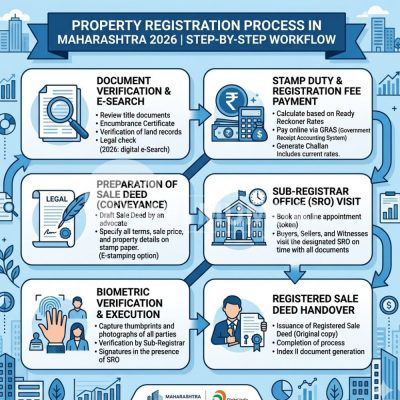
Buying your first home is an exciting milestone, but understanding the Property Registration Maharashtra process is equally important before completing the purchase. After years of saving and searching for the right property, many buyers focus on location, price, and amenities while overlooking the legal formalities that establish ownership. However, property registration is the step that legally transfers ownership from the seller to the buyer and protects your investment for the future.
Whether you’re purchasing a flat in Mumbai, a villa in Pune, or a plot in Navi Mumbai, knowing how the Property Registration Maharashtra process works can help you avoid delays, legal issues, and unnecessary expenses. Therefore, this guide explains every step involved in registering a property in Maharashtra in 2026.
Before proceeding with registration, it’s also important to understand the complete home-buying journey. You can read our guide on How to Buy Your First Home in Maharashtra for a detailed overview of the process.
Why Property Registration Is More Important Than Ever in 2026
Property registration offers several important benefits. First, it gives you legal ownership of the property. Second, it creates an official government record that serves as proof of ownership. Moreover, it protects buyers from fraudulent claims and ownership disputes. It also makes future resale transactions easier and more transparent. In addition, registered properties are often preferred by banks when approving home loans. Finally, registration helps ensure smooth inheritance and ownership transfers in the future.
Without proper registration, proving ownership can become difficult if disputes arise later. Therefore, every buyer should treat property registration as a crucial step rather than just another formality.
This version reduces repetitive sentence beginnings and usually removes the “consecutive sentences starting with the same word” warning in Rank Math and Yoast.
What Is Property Registration?
Property registration is the legal process through which ownership rights are officially transferred from the seller to the buyer and recorded with the government.
In Maharashtra, the registration process is managed by the Registration and Stamps Department. Once the property is registered, the transaction becomes part of the official public record.
In simple terms, registration acts as the final legal seal on your property purchase.
As a result, your ownership rights become legally enforceable and recognized by government authorities.
For the latest registration procedures and official guidelines, buyers can visit the Maharashtra Registration and Stamps Department website, which provides updated information on property registration services.
Step 1: Verify Property Documents Thoroughly
Before moving forward with registration, it is essential to verify all property documents. Although many buyers trust developers or brokers, independent verification remains crucial.
For Under-Construction Properties
Ensure the following documents are available:
- Allotment Letter
- Builder-Buyer Agreement
- Approved Building Plans
- Commencement Certificate
- RERA Registration Details
For Ready-to-Move Properties
Verify:
- Sale Deed
- Occupancy Certificate
- Completion Certificate
- Property Tax Receipts
- Society NOC
For Resale Properties
Check:
- Previous Sale Deeds
- Encumbrance Status
- Share Certificate
- Maintenance Dues Clearance
- Seller Identity Proof
Furthermore, engaging a qualified property lawyer can help identify potential issues before they become costly problems.
Before purchasing an under-construction property, buyers should verify the project’s registration details on the Maharashtra Real Estate Regulatory Authority (MahaRERA) website, which provides information about approved projects, developers, and regulatory compliance.
Step 2: Calculate Stamp Duty and Registration Charges
Once document verification is complete, the next step is calculating the applicable government charges.
Generally, buyers must pay:
Stamp Duty
Stamp duty is a government tax levied on property transactions. The amount depends on factors such as:
- Property location
- Market value
- Agreement value
- Property category
Registration Charges
In addition to stamp duty, registration fees are payable for recording the transaction with the government.
Since government policies can change periodically, it is advisable to verify the latest applicable rates before making payments.
Consequently, proper financial planning becomes easier and unexpected expenses can be avoided.
Step 3: Draft and Review the Sale Deed
The Sale Deed is arguably the most important document in the entire transaction.
It contains critical information such as:
- Buyer details
- Seller details
- Property specifications
- Transaction value
- Payment schedule
- Ownership transfer clauses
- Possession details
However, many first-time buyers sign the Sale Deed without carefully reviewing its contents.
This can be a costly mistake.
Therefore, every clause should be reviewed thoroughly. If necessary, seek legal advice before signing the document.
Step 4: Pay Stamp Duty Online
Fortunately, Maharashtra has embraced digitalization, making property transactions much more convenient.
Today, buyers can pay stamp duty online through authorized government platforms.
Typically, the process involves:
- Entering property details
- Calculating applicable duty
- Making payment online
- Generating payment receipts
- Downloading proof of payment
As a result, the process is faster, more transparent, and significantly less cumbersome than traditional methods.
Fortunately, Maharashtra allows buyers to pay stamp duty online. To verify current charges and complete payments, you can access the official e-Payment portal available through the Maharashtra Registration and Stamps Department website
Step 5: Book an Appointment With the Sub-Registrar
After completing the payment process, buyers must schedule an appointment with the Sub-Registrar Office.
This appointment system helps streamline registrations and reduce waiting times.
Ideally, choose a date when:
- Buyer is available
- Seller is available
- Witnesses can attend
- All documents are ready
Otherwise, missing documentation may result in delays and rescheduling.
Step 6: Arrange All Required Documents
Before visiting the registration office, ensure every required document is readily available.
Buyer Documents
- Aadhaar Card
- PAN Card
- Passport-size photographs
- Address proof
Seller Documents
- Aadhaar Card
- PAN Card
- Property ownership documents
- Tax payment receipts
Property Documents
- Sale Deed
- Stamp Duty Receipt
- Property Card
- Society NOC (if applicable)
Additional Documents
- Home Loan Approval Letter
- Power of Attorney (if applicable)
- Witness Identity Proof
Moreover, keeping photocopies and digital backups can help avoid last-minute complications.
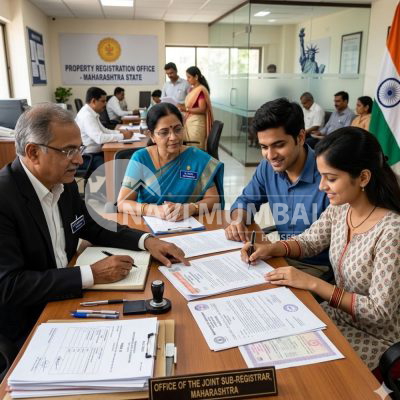
Step 7: Visit the Sub-Registrar Office
On the scheduled date, all parties involved must be present.
This typically includes:
- Buyer
- Seller
- Two witnesses
During the appointment, officials verify:
- Identity documents
- Property information
- Payment records
- Legal documentation
Subsequently, the registration process moves to biometric verification.
Step 8: Complete Biometric Verification
To improve security and reduce fraud, Maharashtra’s registration system includes biometric verification.
This process generally involves:
- Fingerprint scanning
- Photograph capture
- Digital signatures
As a result, fraudulent property transfers become significantly more difficult.
Furthermore, biometric authentication strengthens the legal validity of the transaction.
Step 9: Document Scanning and Registration Approval
After successful verification, the authorities digitally scan all submitted documents.
Thereafter, the transaction details are entered into official government records.
Once approved:
- A registration number is generated
- Documents are digitally archived
- Ownership records are updated
Consequently, a permanent and secure record of the transaction is created.
Step 10: Receive the Registered Sale Deed
Finally, the registration process is completed.
The registered Sale Deed serves as official proof of ownership and confirms that the property has been legally transferred to the buyer.
At this stage:
- Ownership rights become legally enforceable
- Government records are updated
- Future resale becomes easier
Therefore, it is extremely important to store this document safely and maintain multiple backups.
Common Mistakes First-Time Buyers Should Avoid
Skipping Legal Verification
Many buyers assume that a reputed builder automatically guarantees a clear title.
However, independent verification remains essential.
Underreporting Transaction Value
Some buyers attempt to reduce costs by undervaluing the transaction.
Although this may seem beneficial initially, it can lead to future tax and legal complications.
Therefore, complete transparency is always the safer approach.
Ignoring Society Dues
In resale transactions, pending maintenance charges can become the buyer’s responsibility.
Hence, obtaining clearance certificates is highly recommended.
Signing Documents Without Reading
Surprisingly, many buyers sign documents without reviewing every clause.
Nevertheless, even a minor error can create significant issues later.
Therefore, always read documents carefully before signing.
How Property Registration Protects Your Future
A registered property is much more than a physical asset.
Instead, it becomes a foundation for long-term financial security.
With proper registration, you can:
- Sell the property easily
- Obtain loans against the asset
- Transfer ownership to heirs
- Avoid legal disputes
- Build long-term wealth
Moreover, as Maharashtra’s real estate market continues to expand, legally documented ownership becomes increasingly valuable.
For buyers investing in growth corridors such as Navi Mumbai, Pune, Thane, and the Mumbai Metropolitan Region, proper registration ensures that future appreciation remains fully protected.

Final Thoughts
Buying your first property is one of life’s most rewarding achievements. However, true ownership begins only after the registration process is completed.
Fortunately, the Property Registration Process in Maharashtra 2026 has become faster, more transparent, and more digitally accessible than ever before. Nevertheless, buyers must still exercise caution, verify documents thoroughly, and complete every legal requirement correctly.
Ultimately, a few extra hours spent on due diligence today can protect an investment worth lakhs—or even crores—tomorrow.
Therefore, before signing any agreement or completing any transaction, ensure you understand the registration process completely and seek professional guidance whenever necessary.
Because when it comes to real estate, the smartest investment is not just buying the right property—it’s securing your ownership the right way.
Before finalizing any property transaction, it is advisable to verify project approvals through the MahaRERA website and check the latest registration guidelines on the Maharashtra Registration and Stamps Department portal to ensure complete legal compliance.