
Flat Cost Navi Mumbai: Hidden Charges First-Time Buyers Must Know

Understanding the flat cost Navi Mumbai buyers actually pay is crucial before purchasing a home. Many first-time buyers focus only on the property’s advertised price. However, the actual cost is often much higher. Besides the base price, you must account for stamp duty, registration charges, GST, parking fees, maintenance deposits, and interior expenses.
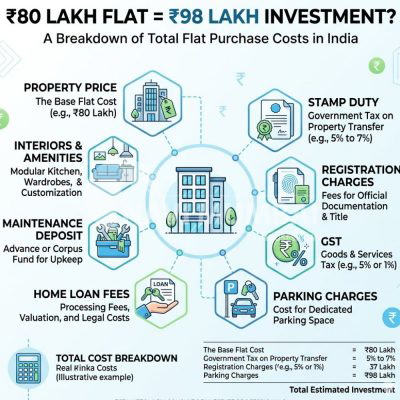
For example, a flat listed at ₹80 lakh may eventually cost close to ₹1 crore. As a result, buyers who fail to calculate the complete budget can face financial stress later. Therefore, before booking any property, it is important to understand every expense involved.
This guide explains the true flat cost in Navi Mumbai and helps first-time buyers make smarter financial decisions.
Before calculating the total cost of a property, it is equally important to understand which locations offer the best long-term value. You can explore our guide on Best Areas to Buy Property in Navi Mumbai for a detailed location comparison.
Large-scale infrastructure projects are shaping Navi Mumbai’s growth story. For example, the upcoming Navi Mumbai International Airport is expected to improve regional connectivity and boost real estate demand. You can learn more about the project on the official website of CIDCO.
Why Understanding the True Cost Matters Today
To begin with, Navi Mumbai is no longer just an affordable alternative to Mumbai.
Instead, it has become one of the most sought-after real estate destinations in the Mumbai Metropolitan Region.
Several factors are driving this growth.
For instance, the city is benefiting from:
- Navi Mumbai International Airport
- Mumbai Trans Harbour Link (MTHL)
- Expanding Metro Network
- Growing Commercial Hubs
- Improved Road Connectivity
As a result, buyer demand continues to increase across locations such as Kharghar, Ulwe, Panvel, Taloja, Ghansoli, Airoli, and Nerul.
Consequently, property values have shown steady growth.
Moreover, many first-time buyers now see Navi Mumbai as a long-term residential destination rather than a secondary market.
However, rising demand also means higher financial commitments.
Therefore, understanding every expense before buying has become more important than ever.
Moreover, the Mumbai Trans Harbour Link has significantly reduced travel time between Mumbai and Navi Mumbai. As a result, several micro-markets are attracting both homebuyers and investors. Detailed project information is available on the Mumbai Metropolitan Region Development Authority (MMRDA)
Step 1: Start with the Property Price
First, calculate the agreement value.
This is the base price of the flat.
Let’s assume the property costs:
₹80,00,000
At this stage, many buyers believe this amount represents their total investment.
However, several mandatory expenses are still pending.
Therefore, treat the property price as the starting point rather than the final cost.
Step 2: Add Stamp Duty and Registration Charges
Next, you must account for government charges.
These expenses are mandatory and cannot be avoided.
Example
Property Value: ₹80,00,000
Stamp Duty (Approx. 5%)
₹80,00,000 × 5% = ₹4,00,000
Registration Charges
Approximately ₹30,000 to ₹50,000
Therefore, your additional expense becomes:
₹4.3 lakh to ₹4.5 lakh
As a result, your overall budget immediately increases.
Unfortunately, many buyers forget to reserve funds for these payments.
Consequently, they face financial pressure during registration.
Step 3: Check Whether GST Applies
After that, determine whether GST is applicable.
This depends on the construction status of the property.
Under-Construction Property
GST applies.
Ready-to-Move Property
GST does not apply.
Currently, GST rates are:
- 1% for affordable housing
- 5% for non-affordable housing
For example, if your under-construction apartment costs ₹80 lakh, GST at 5% would amount to:
₹4,00,000
Therefore, your acquisition cost rises further.
Because of this, many buyers compare ready-to-move homes and under-construction projects before making a decision.
Step 4: Include Parking Charges
In addition, remember to account for parking costs.
Many developers charge separately for parking spaces.
Typically, charges may look like this:
- Open Parking: ₹1–2 lakh
- Covered Parking: ₹3–6 lakh
- Premium Parking: Higher
Let’s assume your parking space costs:
₹3,00,000
Although parking may seem like a minor expense, it can significantly affect your final budget.
Therefore, always ask whether parking is included in the quoted price.
Step 5: Add Floor Rise and Premium Charges
Furthermore, developers often charge premiums for preferred units.
For example, extra charges may apply for:
- Higher floors
- Garden-facing units
- Corner apartments
- Club-facing homes
- Better views
Let’s assume:
Floor Rise Premium = ₹1.5 lakh
As a result, your total acquisition cost increases again.
Therefore, always request a detailed cost sheet before booking.
Step 6: Calculate Home Loan Expenses
Most buyers focus on EMIs.
However, loan-related charges also add to the overall cost.
Typically, banks charge:
Processing Fees
Usually between 0.25% and 1% of the loan amount.
For a ₹60 lakh loan:
₹15,000 to ₹60,000
Additional Charges
- Legal Verification
- Technical Evaluation
- Documentation Charges
Together, these expenses may range from ₹20,000 to ₹50,000.
Although these costs appear small, they should still be included in your calculations.
Step 7: Budget for Maintenance and Society Deposits
Meanwhile, developers often collect several one-time payments before possession.
These may include:
- Maintenance Advance
- Corpus Fund
- Sinking Fund
- Clubhouse Charges
Typically, buyers pay:
₹50,000 to ₹2 lakh or more
The exact amount depends on the project’s amenities and size.
Therefore, ask for complete details before finalizing your purchase.
Step 8: Factor in Interior Costs
Now, let’s discuss one of the most underestimated expenses.
Interior work.
A flat may be ready for possession.
However, it may not be ready for comfortable living.
Most homeowners invest in:
- Modular Kitchen
- Wardrobes
- Lighting
- Fans
- Storage Solutions
- Curtains
Estimated Cost
Basic Interior Setup:
₹3–6 lakh
Premium Interior Setup:
₹8–20 lakh or more
Consequently, interior expenses can dramatically increase the total cost of ownership.
Therefore, they should never be ignored.
Step 9: Include Moving and Setup Costs
Finally, don’t forget the smaller expenses.
Although they may seem minor individually, they can add up quickly.
These costs may include:
- Packers and Movers
- Internet Installation
- Gas Connection
- Furniture Purchases
- Appliance Upgrades
Typically, buyers spend:
₹50,000 to ₹2 lakh
As a result, the overall investment becomes even higher.
Real Example: The True Cost of an ₹80 Lakh Flat
| Expense | Estimated Cost |
|---|---|
| Property Price | ₹80,00,000 |
| Stamp Duty | ₹4,00,000 |
| Registration | ₹40,000 |
| GST | ₹4,00,000 |
| Parking | ₹3,00,000 |
| Floor Rise Premium | ₹1,50,000 |
| Loan Charges | ₹50,000 |
| Maintenance Deposit | ₹1,00,000 |
| Basic Interiors | ₹4,00,000 |
| Moving Expenses | ₹60,000 |
Total Estimated Cost
₹98,00,000+
Therefore, a flat advertised at ₹80 lakh may actually require a budget close to ₹1 crore.
This is the figure that should guide your financial planning.
Why Smart Investors Focus on Total Cost
In fact, experienced investors rarely evaluate a property based only on its listed price.
Instead, they calculate the total acquisition cost.
After all, investment returns depend on the actual amount invested.
Therefore, they analyze:
- Total Purchase Cost
- Future Appreciation Potential
- Rental Yield
- Holding Costs
As a result, they make more informed decisions.
Similarly, first-time buyers should adopt the same approach.
A Home Is Emotional-But the Numbers Matter
Without a doubt, buying a home is an emotional decision.
It represents security, achievement, and long-term stability.
Moreover, it creates a sense of belonging.
However, emotions alone should not drive the purchase.
Instead, successful buyers balance emotion with financial discipline.
They choose a home they love.
At the same time, they ensure the numbers work.
Consequently, they enjoy homeownership without unnecessary financial stress.
Furthermore, first-time buyers should compare loan offers from multiple lenders before making a decision. For example, the official State Bank of India Home Loans page provides information on current home loan products and eligibility criteria.
Common Mistakes First-Time Buyers Make
“I Only Calculated My Down Payment”
Unfortunately, this is very common.
Therefore, always budget for additional expenses.
“The Builder Gave Me the Final Price”
Not necessarily.
In fact, several charges may still be excluded.
Therefore, ask for a detailed cost sheet.
“I Can Do Interiors Later”
While that is possible, basic interior work is often essential.
Therefore, include it in your budget from the beginning.
“My Loan Covers Everything”
In most cases, it doesn’t.
As a result, buyers need additional funds beyond the loan amount.
A Simple Formula Every Buyer Should Follow
Before purchasing any flat in Navi Mumbai, use this formula:
True Cost = Property Price + Stamp Duty + Registration + GST + Parking + Premium Charges + Loan Costs + Maintenance Deposits + Interiors + Moving Expenses
If this figure fits comfortably within your budget, you are financially prepared.
However, if the number feels stretched, reconsider your property budget.
In addition, buyers should verify project approvals and regulatory compliance before booking a property. Project details registered under the real estate regulator can be checked on the official MahaRERA Portal website.

Final Thoughts
Ultimately, Navi Mumbai is entering a strong growth phase.
Infrastructure projects are improving connectivity. Meanwhile, commercial development continues to attract businesses and professionals.
As a result, housing demand remains strong.
Therefore, buying a home in Navi Mumbai can be a smart long-term move.
However, success depends on preparation.
Before making any commitment, calculate every expense carefully.
After all, the true cost of a property is not the number displayed in the brochure.
Instead, it is the amount you ultimately spend to own, maintain, and enjoy that home.
So, take the time to calculate the complete picture.
By doing so, you can buy with confidence, avoid surprises, and make a financially sound decision.
Finally, staying informed is one of the best ways to make a confident property decision. Therefore, buyers should regularly review updates from MahaRERA, CIDCO, and MMRDA to track infrastructure developments that may influence property values across Navi Mumbai.