
What Is a Completion Certificate and Why You Should Never Buy Without It

A Completion Certificate is one of the most important documents in real estate, yet many homebuyers overlook it in the excitement of purchasing a property. Imagine finally receiving the keys to your dream home. The interiors are complete, the building stands tall, and your family is already planning the housewarming celebration. At that moment, everything seems perfect.
However, what if a critical document is missing?
Months after moving in, some homeowners discover that their building lacks a valid Completion Certificate. Consequently, they face unexpected challenges ranging from delayed utility approvals to difficulties during resale. In some cases, authorities may even identify portions of the construction as unauthorized.
Suddenly, what appeared to be a secure investment begins to reveal hidden risks.
What Is a Completion Certificate?
A Completion Certificate (CC) is an official document issued by the local municipal authority or development authority after a detailed inspection of a completed building.
Essentially, the certificate confirms that the project has been constructed according to approved plans and complies with applicable regulations.
More specifically, it verifies that:
- Construction has been completed according to the sanctioned building plan.
- The project complies with local building regulations.
- Structural safety norms have been followed.
- Zoning and development guidelines have been met.
- The building satisfies all mandatory requirements established by the relevant authorities.
In simple terms, a Completion Certificate serves as official proof that the construction has been completed legally and in accordance with approved specifications.
Without this document, a building may physically exist. However, its legal standing can become questionable.

Why a Completion Certificate Matters More Than Ever
India’s real estate landscape has undergone a significant transformation over the last decade.
Thanks to increased transparency, stricter regulations, and the implementation of the Real Estate Regulatory Authority (RERA), buyers today are more informed than ever before. As a result, documentation has become just as important as location, pricing, and amenities.
In the past, many buyers focused primarily on possession dates and property features. Today, however, savvy investors evaluate a project’s legal compliance before making a commitment.
Moreover, rapid urbanization and rising property values have made due diligence a crucial part of every purchase decision.
Consequently, a Completion Certificate has become one of the most important indicators of a property’s long-term security and legitimacy.
Buyers can verify project registrations, approvals, and compliance details through the official RERA portal, which has significantly improved transparency in India’s real estate sector. For more information, visit the RERA official website.
Risks of Buying Property Without a Completion Certificate
Many buyers assume that if a building looks complete, it must be legally complete as well.
Unfortunately, that assumption can prove costly.
1. Legal Vulnerability
In many cases, buildings without Completion Certificates contain deviations from approved plans.
For example, developers may have:
- Added unauthorized floors
- Modified layouts without approval
- Violated setback requirements
- Exceeded permissible Floor Space Index (FSI)
- Made structural changes that were never sanctioned
As a result, buyers may become exposed to legal uncertainties despite purchasing the property in good faith.
Furthermore, resolving such issues can consume considerable time, money, and emotional energy.
2. Challenges in Obtaining Occupancy Permissions
A Completion Certificate often serves as a prerequisite for obtaining an Occupancy Certificate (OC).
Therefore, projects lacking proper approvals may encounter complications related to:
- Water supply connections
- Sewage infrastructure
- Electricity approvals
- Municipal services
After all, a home is more than a physical structure. It must also function seamlessly within the city’s infrastructure network.
3. Financing and Loan Complications
Banks and financial institutions conduct extensive due diligence before approving property loans.
Consequently, projects lacking proper documentation may face:
- Delayed loan approvals
- Reduced property valuations
- Additional scrutiny
- Financing restrictions
Moreover, even if you purchase the property using your own funds today, future buyers may depend on bank financing.
As a result, the property’s resale potential can suffer significantly.
4. Lower Resale Value
Modern buyers ask more questions than ever before.
In addition to checking the title deed, many now request:
- RERA registration details
- Occupancy Certificates
- Completion Certificates
- Legal verification reports
Consequently, any missing approval immediately raises concerns.
In contrast, fully compliant properties tend to attract stronger demand and command better prices.
5. Risk of Penalties and Regulatory Action
While extreme situations are uncommon, unauthorized construction can sometimes attract regulatory action.
Many buyers believe authorities only target developers. However, homeowners often experience the consequences as well.
Depending on the severity of the violation, residents may face penalties, prolonged legal disputes, or restrictions related to the property.
Needless to say, such situations can be both financially and emotionally draining.
How a Completion Certificate Protects Your Property Investment
For most families, real estate represents one of the largest investments they will ever make.
Fortunately, a Completion Certificate helps protect that investment in multiple ways.
Completion Certificate Provides Legal Assurance
First and foremost, the document confirms that the building complies with approved plans and applicable regulations.
Therefore, buyers gain greater confidence in the legitimacy of their purchase.
Completion Certificate Simplifies Property Transactions
When it comes time to sell, refinance, or transfer ownership, documentation becomes critically important.
As a result, certified properties are generally easier to:
- Sell
- Mortgage
- Refinance
- Transfer
- Lease
Additionally, transactions involving compliant properties tend to move faster and face fewer obstacles.
Completion Certificate Supports Long-Term Property Value
As buyer awareness continues to rise, documentation quality increasingly influences property values.
Notably, properties backed by complete approvals often maintain stronger market credibility over time.
Completion Certificate Helps Reduce Future Risks
The smartest investment is not necessarily the cheapest one.
Rather, it is the investment with the lowest hidden risk.
By ensuring compliance from the outset, a Completion Certificate helps eliminate numerous uncertainties before they become costly problems.
Completion Certificate vs Occupancy Certificate: Key Differences Every Buyer Should Know
Many buyers mistakenly assume these documents are identical.
In reality, they serve different purposes.
| Completion Certificate | Occupancy Certificate |
|---|---|
| Confirms construction complies with approved plans | Confirms the building is fit for occupation |
| Issued after construction inspection | Issued before legal occupancy |
| Focuses on structural and regulatory compliance | Focuses on habitability and civic infrastructure |
| Typically obtained first | Usually issued afterward |
Simply put, a Completion Certificate confirms the project was built correctly.
An Occupancy Certificate, on the other hand, confirms that residents can legally and safely occupy the building.
Ideally, buyers should verify the availability of both documents.
How to Verify a Completion Certificate Before Buying Property
Before signing any agreement, take the following precautions.
Ask the Developer for the Completion Certificate
To begin with, request a copy of the Completion Certificate directly from the builder.
A credible developer should provide the document without hesitation.
Verify the Completion Certificate Through Local Authorities
Next, cross-check the certificate with the municipal corporation or relevant development authority.
Doing so adds a layer of protection.
Consult a Lawyer to Validate the Completion Certificate
Furthermore, professional legal verification can uncover discrepancies that buyers may overlook.
Compared to the value of the investment, the cost of legal due diligence is relatively small.
Furthermore, buyers should familiarize themselves with consumer rights and property-related protections before making a purchase. Useful guidance is available through the National Consumer Helpline.
Check RERA Records for Completion Certificate Details
Finally, review the project’s details on the relevant state RERA portal.
Many approvals and compliance updates are available publicly, making verification easier than ever.
Additionally, many state authorities provide online access to project approvals and building records, making independent verification easier for homebuyers. You can also review housing-related regulations on the Ministry of Housing and Urban Affairs website.
A Real-World Scenario Every Buyer Should Consider
Consider two apartment projects located in the same neighborhood.
Project A offers a slightly lower price.
Meanwhile, Project B costs a little more but possesses every required approval, including a Completion Certificate.
At first glance, Project A appears to be the better bargain.
However, the long-term picture tells a different story.
Over the next decade:
- Project B attracts stronger buyer demand.
- Financing remains easier.
- Resale transactions move faster.
- Legal risks remain lower.
- Property appreciation benefits from greater market confidence.
Consequently, the small premium paid upfront often translates into stronger wealth preservation and higher returns over time.
This is precisely why experienced investors prioritize compliance before discounts.
The Emotional Side of the Decision
A home is far more than a financial asset.
For many families, it symbolizes stability, security, and achievement.
Moreover, it often represents years of savings and sacrifice.
No homeowner wants to spend years worrying about missing approvals, regulatory notices, or future resale complications.
Instead, they want peace of mind.
Fortunately, a Completion Certificate provides exactly that.
When documentation is complete, homeowners can focus on enjoying their property rather than worrying about unforeseen legal issues.
Ultimately, that confidence is invaluable.
Moreover, homebuyers can review approved building standards and urban development guidelines through resources published by the National Building Code of India information portal.
Common Myths About Completion Certificates
“The Building Is Ready, So the Certificate Doesn’t Matter”
This is one of the most common misconceptions.
In reality, physical completion and legal completion are two very different things.
“The Builder Said It Will Be Issued Soon”
Promises are not legal documents.
Therefore, buyers should always verify approvals independently before proceeding.
“I Can Get It Later”
Unfortunately, obtaining approvals after purchase is often far more complicated than buyers expect.
For that reason, verification should happen before the transaction is completed.
“Only Investors Need to Worry About It”
Not at all.
Whether you plan to live in the property or use it as an investment, compliance affects financing, resale, legal security, and future value.
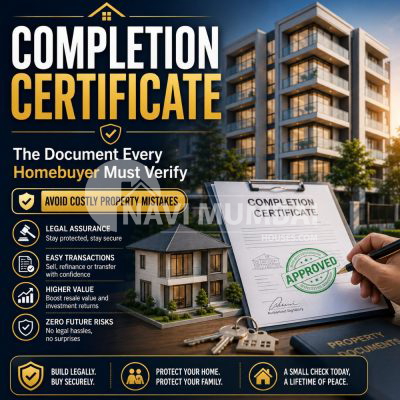
Final Thoughts: Never Let Excitement Override Due Diligence
Purchasing property is one of the most significant financial decisions most people will ever make.
Certainly, location matters.
Amenities matter.
Pricing matters.
However, none of these factors should take priority over legal compliance.
A Completion Certificate is not merely another piece of paperwork.
Rather, it is proof that your future home has been built according to approved standards and recognized by the appropriate authorities.
As India’s real estate market becomes increasingly transparent and regulated, informed buyers are paying closer attention to documentation than ever before.
Therefore, before signing any agreement, transferring funds, or committing your life’s savings, verify the Completion Certificate.
After all, the smartest property purchase is not simply about finding the right home.
Instead, it is about securing a home that is legally sound, financially secure, and built to protect your future for decades to come.
As regulatory oversight continues to strengthen, staying informed through official government resources can help buyers make safer investment decisions. Recent policy updates and housing initiatives can be tracked via the Government of India portal.