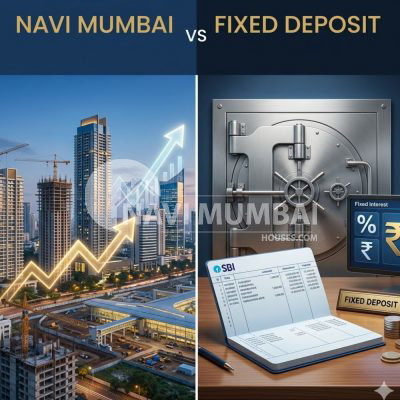
Real Estate vs Fixed Deposit: Better Returns in Navi Mumbai?
Real Estate vs Fixed Deposit is one of the biggest investment debates among investors in 2026. While Fixed Deposits offer safety, predictable returns, and low risk, real estate provides opportunities for capital appreciation, rental income, and long-term wealth creation. Therefore, many investors are comparing these two options to determine which investment can generate better returns and build greater wealth over time.
Imagine you have ₹50 lakh ready to invest today. On one hand, you could place the money in a Fixed Deposit and earn guaranteed returns. On the other hand, you could invest in a property in Navi Mumbai and potentially benefit from appreciation, rental income, and future infrastructure-led growth.
Moreover, Navi Mumbai is emerging as one of India’s most promising real estate markets, thanks to major developments such as the Navi Mumbai International Airport, Metro expansion, and improved connectivity. As a result, investors are increasingly evaluating whether property can outperform traditional fixed-income investments.
Understanding the Two Investment Options
What is a Fixed Deposit?
A Fixed Deposit (FD) is one of India’s most popular investment instruments. Investors deposit a lump sum amount with a bank or financial institution for a fixed tenure and earn a predetermined interest rate.
Benefits of Fixed Deposits
Guaranteed returns
Low investment risk
Capital protection
Predictable maturity amount
Better liquidity compared to property investments
However, while FDs offer stability, they generally provide limited wealth creation opportunities over the long term.
What is Real Estate Investment?
Real estate investment involves purchasing residential or commercial property to generate returns through appreciation and rental income.
Unlike an FD, real estate is a tangible asset that can create multiple income streams. Furthermore, property values often rise alongside economic growth and infrastructure development.
Investors typically earn through:
Capital appreciation
Rental income
Future resale profits
Asset ownership and leverage
Therefore, many investors consider real estate a powerful long-term wealth-building tool.
The 2026 Investment Landscape
Several factors are reshaping investment decisions in 2026. For instance, infrastructure development, inflation, and changing buyer behavior are influencing where investors choose to allocate their capital. As a result, both FDs and real estate are being evaluated more carefully than ever before.
Rising Infrastructure Development
Navi Mumbai is witnessing transformational projects that are changing the region’s investment potential.
Major developments include:
Navi Mumbai International Airport
Mumbai Trans Harbour Link (Atal Setu)
Metro Rail Expansion
Coastal Road Connectivity
Commercial and IT Hub Development
Consequently, these projects are improving connectivity, attracting businesses, and increasing residential demand.
Furthermore, improved infrastructure typically leads to stronger property appreciation over time. Therefore, many investors see Navi Mumbai as a long-term growth destination rather than merely a housing market.
Inflation Remains a Reality
Even if an FD offers 7% annual interest, inflation can significantly reduce actual purchasing power.
For example:
FD Return: 7%
Inflation: 5–6%
The real return may be only around 1–2%.
Because of this, investors increasingly seek assets that can potentially outperform inflation. Real estate, particularly in growth corridors, has historically offered this advantage through appreciation and rental income.
For instance, investors can track official inflation trends through the Reserve Bank of India’s published economic data and reports.
Navi Mumbai Real Estate Returns in 2026
Capital Appreciation Potential
Historically, infrastructure-driven markets have delivered significant appreciation. Similarly, areas such as Kharghar, Ulwe, Panvel, Seawoods, and Taloja have benefited from improved connectivity and rising demand.
Moreover, as employment hubs expand and population growth continues, property prices often experience upward pressure. Therefore, investors who enter early may benefit from stronger long-term gains.
Several locations in Navi Mumbai are currently attracting investor attention due to upcoming infrastructure projects and increasing end-user demand.
As a result, property prices in strategic locations continue to show positive growth momentum.
One major advantage of real estate is rental yield.
For example, a property worth ₹50 lakh may generate monthly rent ranging from ₹15,000 to ₹25,000 depending on the location and property type.
Consequently, investors can earn annual rental income while simultaneously benefiting from capital appreciation.
Potential annual rental income:
₹1.8 lakh to ₹3 lakh
Additional cash flow every year
Inflation-adjusted income growth over time
In contrast, an FD generates only interest income and does not provide a secondary income stream.
Leverage Multiplies Wealth Creation
Another powerful advantage of real estate is leverage.
For instance, an investor may contribute ₹20 lakh as a down payment and purchase an ₹80 lakh property through financing.
As a result, appreciation occurs on the full property value rather than only on the invested capital.
Let’s understand this better:
Investor Capital: ₹20 lakh
Property Value: ₹80 lakh
If the property appreciates by 10%, the gain is calculated on ₹80 lakh, not ₹20 lakh.
Therefore, even moderate price growth can significantly increase overall returns compared to traditional fixed-income investments.
Fixed Deposit Returns in 2026
Predictability and Safety
The biggest strength of an FD is certainty.
Investors know:
The exact interest rate
Maturity value
Investment tenure
Risk exposure
However, while predictability reduces risk, it can also limit growth potential. Therefore, investors seeking higher wealth creation often explore alternatives such as real estate.
Expected FD Returns in 2026
Most major banks currently offer FD interest rates ranging between:
6.5% to 7.5% annually
While these returns are attractive for conservative investors, they rarely generate significant wealth over long periods.
Moreover, FD returns are taxable according to the investor’s tax slab, which may further reduce effective returns.
Real Estate vs Fixed Deposit: Side-by-Side Comparison
Factor
Navi Mumbai Real Estate
Fixed Deposit
Capital Appreciation
High Potential
None
Rental Income
Yes
No
Inflation Protection
Strong
Weak
Liquidity
Moderate
High
Risk Level
Moderate
Low
Wealth Creation Potential
High
Limited
Leverage Benefits
Yes
No
Tangible Asset Ownership
Yes
No
A Practical Investment Comparison
Let’s compare an investment of ₹50 lakh over a five-year period.
Scenario 1: Fixed Deposit
Investment Amount: ₹50 lakh
Average Return: 7% annually
Approximate Value After 5 Years:
₹70 lakh
The returns remain stable and predictable. However, growth is limited.
Scenario 2: Navi Mumbai Real Estate
Property Value: ₹50 lakh
Assumed Appreciation: 8% annually
Estimated Property Value After 5 Years:
₹73–74 lakh
In addition, rental income over five years could generate approximately ₹9–15 lakh.
Therefore, the total wealth generated can significantly exceed FD returns.
This example demonstrates why many investors prefer real estate during infrastructure-driven growth cycles.
Why Investors Are Looking at Navi Mumbai in 2026
Several developments are creating investor confidence.
Firstly, major infrastructure projects are improving connectivity. Secondly, employment opportunities are expanding across the region. Finally, housing demand continues to rise due to population growth and business expansion.
As a result, Navi Mumbai is increasingly being viewed as a long-term investment destination.
The Navi Mumbai International Airport is expected to become one of India’s most influential infrastructure projects.
Historically, airports have transformed surrounding real estate markets. Similarly, experts expect significant economic activity around the airport region in the coming years.
Consequently, nearby residential and commercial properties could experience substantial growth in demand.
Businesses are increasingly expanding into Navi Mumbai.
These include:
IT Companies
Startups
Logistics Firms
Financial Services Organizations
Therefore, rising employment opportunities are supporting both housing demand and rental growth.
Better Affordability Compared to Mumbai
Compared to many parts of Mumbai, Navi Mumbai still offers relatively affordable entry points.
As a result, buyers can access larger properties and potentially benefit from future appreciation.
Moreover, affordability often attracts first-time homebuyers, which further strengthens demand.
Common Investor Concerns
What If Property Prices Stop Growing?
This is one of the most common concerns among investors.
However, temporary market slowdowns are a normal part of any real estate cycle.
Nevertheless, locations supported by strong infrastructure, employment growth, and population expansion generally recover over time.
Therefore, long-term investors often focus on fundamentals rather than short-term fluctuations.
What About Liquidity?
Property is less liquid than an FD.
However, real estate should ideally be viewed as a medium-to long-term investment.
Furthermore, investors who choose strategically located properties often benefit from stronger resale demand when they decide to exit.
Are FDs Completely Safe?
FDs are generally considered safer investments.
However, they face a different challenge—inflation erosion.
While your capital may grow steadily, its purchasing power may not increase at the same pace.
Therefore, investors seeking real wealth growth often diversify beyond fixed-income products.
Before making any investment decision, investors should review official infrastructure updates from the City and Industrial Development Corporation (CIDCO), as major development projects often influence long-term property values.
The Emotional Side of Investing
Investments are not merely numbers on a statement.
Instead, they represent future goals, family security, and financial freedom.
A Fixed Deposit offers stability.
However, a property offers stability along with ownership.
It is an asset you can see, use, rent, leverage, and pass on to future generations.
Furthermore, property ownership often provides a sense of achievement and security that financial instruments cannot replicate.
Therefore, many investors view real estate as both an emotional and financial asset.
Final Verdict: Which Gives Better Returns in 2026?
If your primary objective is capital preservation and guaranteed returns, a Fixed Deposit remains a reliable choice.
However, if your goal is long-term wealth creation, inflation-beating growth, rental income, and asset ownership, Navi Mumbai real estate offers a compelling opportunity.
Moreover, ongoing infrastructure developments, including the Navi Mumbai International Airport, Metro expansion, and enhanced connectivity, continue to strengthen the region’s growth prospects.
As a result, many investors are positioning themselves before the next phase of appreciation.
Ultimately, the best investment depends on your financial goals, risk tolerance, and investment horizon.
Nevertheless, for investors seeking higher growth potential in 2026, Navi Mumbai real estate appears to have a clear advantage over traditional fixed deposits.
The biggest gains in real estate are often made before a market reaches its full potential—not after.
Therefore, investors who act strategically today may benefit significantly from Navi Mumbai’s next decade of growth.
Additionally, investors should review current fixed deposit rates and financial products directly from the Securities and Exchange Board of India (SEBI) investor education resources before making investment decisions.
Looking to Invest in Navi Mumbai?
Whether you’re a first-time investor or an experienced buyer, choosing the right location can make all the difference.
Explore verified investment opportunities in Kharghar, Ulwe, Panvel, Taloja, and Seawoods with Navi Mumbai Houses and make a smarter investment decision for 2026 and beyond.
Disclaimer: The views of this expressed above are for informational purposes only based on the industry reports & related news stories. Navimumbaihouses.com does not guarantee the accuracy of this article, completeness, or reliability of the information & shall not be held responsible for any action taken based on the published information.